
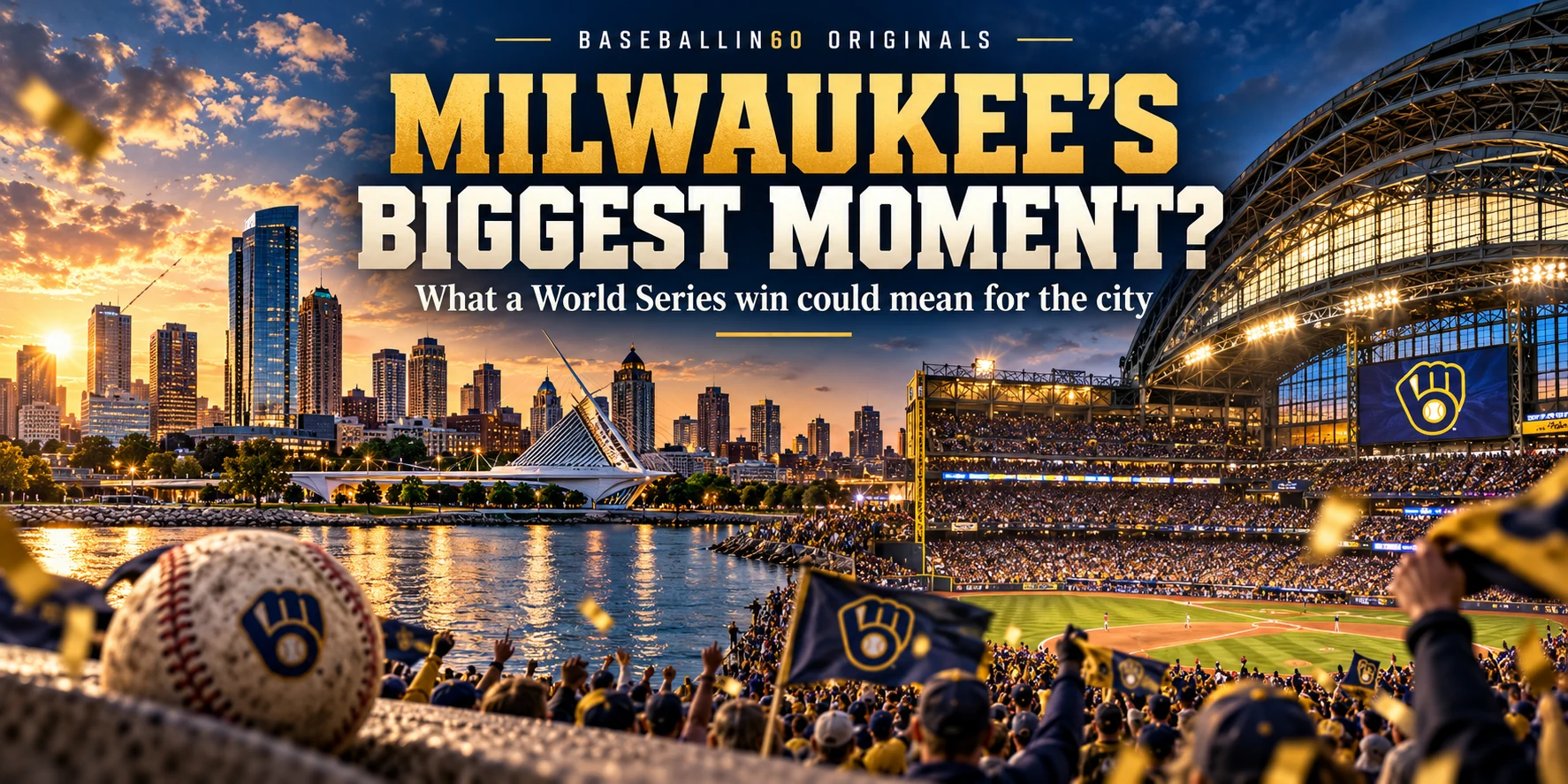
Would a Brewers World Series Title Be Milwaukee’s Biggest Sporting Moment
Baseballin60 Originals ·
A first Brewers championship would carry enormous emotional weight. Its impact on Milwaukee would reach businesses, tourism and the city’s identity, but the biggest legacy may be something a spending estimate cannot measure.
One win from a different place in history
The Milwaukee Brewers stand one victory from their first World Series championship after taking a 3–0 lead over the Tampa Bay Rays. The title has not been won. This is an examination of what a Milwaukee victory would mean, rather than a report of a result that has already happened. [1]
If the Brewers finish the job, the answer to the biggest question is both exciting and more precise than a simple yes: it would be a contender for Milwaukee’s greatest sporting moment, and for many Brewers supporters it would be the greatest. Calling it the biggest thing ever to happen to Milwaukee would go too far. A city’s industrial development, migration, civic struggles and economic changes cannot sensibly be ranked beneath a baseball trophy.
That distinction does not reduce the achievement. A championship would give the Brewers something their own franchise has never possessed. It would turn a long-running hope into a shared date, a final out and a story families could retell for decades.
Milwaukee has celebrated champions before
The city’s baseball history did not begin with the Brewers. In 1957, the Milwaukee Braves defeated the New York Yankees to win the World Series. That remains a central part of Milwaukee’s sporting identity. A Brewers victory would therefore be the franchise’s first World Series title, not the city’s first. [2]
The Bucks added their first NBA championship in 1971, led by Kareem Abdul-Jabbar and Oscar Robertson. Half a century later, the 2021 Bucks championship gave another generation its defining celebration. Neither achievement becomes smaller because baseball might now have its own breakthrough. [3–4]
Then there is 1982. The Brewers reached the World Series and lost to St. Louis in seven games. That team remains part of the city’s sporting memory despite falling short, and supporters still turned out to welcome it home. A title in 2026 would change the ending of the Brewers’ larger story without erasing the affection for that earlier team. [5]
For an older supporter, the emotional comparison might begin with the Braves. For someone who grew up with the 1982 Brewers, it might centre on a lifetime of waiting for a different final chapter. For younger fans, the Bucks’ 2021 championship may be the benchmark. There is no objective instrument that makes one generation’s memory more valuable than another’s.
Why a first Brewers title would feel different
A first championship changes the language around a club. Fans no longer have to explain how close it came, what went wrong or what might happen next year. The franchise has won. That is a distinct emotional achievement even in a city that has already celebrated other champions.
It would also connect people who follow baseball at different levels. The season-ticket holder, the family watching at home and the person joining a crowded neighbourhood bar would all share the same outcome. Some of that participation would be temporary. Some could become the beginning of a lasting attachment to the team.
Milwaukee’s recent success also gives the occasion a national audience. The Brewers would become a reference point in conversations about how clubs build winning teams. That attention creates an opportunity for the city to tell a fuller story about itself. It does not prove that every viewer will visit, invest or move there.
The business boost has already begun
The first economic effect comes from being in the World Series, not from winning it. Visiting fans, media, team personnel and other travellers can spend money on hotels, meals, transport and entertainment while the series is still undecided.
In its October 23 release, Visit Milwaukee projected US$10 million to US$12 million in total economic impact for each home World Series game. Its estimate for earlier postseason home games was US$5.1 million per game. These are tourism-agency estimates of economic activity, not audited profits or money deposited into the city treasury. [6]
Some reporting has quoted a wider World Series estimate of US$10 million to US$15 million per home game. Rather than blend the two into a new figure, the clearest approach is to identify the source and use the tourism agency’s published release for the narrower projection. Neither range measures the additional value of winning the championship itself. [6–7]
Local reporting has already described businesses preparing for larger crowds, themed products and gatherings around the games. Those accounts show how the attention can reach individual operators. They do not establish that every restaurant, shop or neighbourhood benefits equally. [8]
Who is most likely to benefit
Hotels are well placed to capture genuinely new spending from people travelling into the region. Restaurants, bars and transport providers can benefit when those visitors spend beyond the ballpark. Businesses able to turn game nights into a welcoming experience may also attract residents who would otherwise stay at home.
Retailers could see demand for championship clothing and souvenirs if Milwaukee wins. The local benefit depends on where purchases occur and how much of the money stays with local businesses and employees. A large national merchandise sales figure should not automatically be called Milwaukee income.
Workers may gain extra shifts, hours and tips. Owners may gain revenue, but they also face extra staffing, supplies and operating expenses. A packed room can be a valuable night without making every dollar of sales a dollar of profit. Businesses outside the busiest areas may see less benefit, while some residents may avoid congested entertainment districts.
Winning and hosting more games are different outcomes
There is an unusual economic wrinkle in a potential sweep. Milwaukee has already hosted the first two games. Games 4 and 5 are scheduled in the Rays’ market; a return to Milwaukee would require Games 6 or 7. A quick Brewers victory would therefore end the series before those additional home dates. [9]
Supporters would understandably prefer the certainty of a championship to another chance to sell hotel rooms. But an economic analysis must recognise that the quickest victory and the greatest number of home World Series games are different outcomes. The trophy does not retroactively create the visitor spending attached to games that never take place.
Winning away from home could still draw people into Milwaukee’s bars and other gathering places. A later championship celebration could generate another busy period. Those effects would need their own measurement; a home-game projection should not simply be multiplied by a parade or a watch party.
What the Bucks experience tells us
Milwaukee has a useful recent comparison. Visit Milwaukee estimated US$57.6 million in direct, indirect and induced economic impact from the Bucks’ entire 2021 championship playoff run, including US$28 million attributed to the NBA Finals. It also reported approximately US$1.107 million in local taxes across the run. Those are separate measures, not interchangeable totals. [10]
The report identified spending in accommodation, transport, food and drink, retail and other sectors. It helps illustrate the channels through which a deep playoff run can support local activity. It should not be copied as a Brewers forecast. The number of games, venue, timing, visitor mix and wider business conditions differ.
Most importantly, the Bucks estimate covered the playoff journey, not a clean measurement of what winning the final game added compared with losing it. A Brewers impact study would need the same distinction. Participation in the World Series and ownership of the trophy are related, but they are not the same economic event.
Why a large impact estimate needs careful reading
Sports economists distinguish new spending from money residents would have spent elsewhere nearby. If a Milwaukee resident spends a fixed entertainment budget at a baseball gathering rather than another local activity, one business gains but the region may not gain the full amount. Researchers also examine spending that leaves the local economy and ordinary activity displaced by the event. [11]
That does not mean the crowds or busy tills are imaginary. It means the question must be precise. Are we measuring sales, additional visitor spending, business profit, tax revenue or net regional economic benefit? A number that answers one question cannot be used as though it answers all five.
The city has hosted other events with very large reported impacts. A commissioned study of the 2024 Republican National Convention estimated US$321.5 million in total impact on the state and local economy. Its scope and method differ from a baseball estimate, so it is not a direct league table. It nevertheless shows why “largest economic event in Milwaukee history” would require much more evidence than championship excitement. [12]
A championship cannot rebuild the city on its own
A World Series victory would not by itself solve housing affordability, public-service pressures or unequal access to opportunity. A few exceptional business weeks are not the same as sustained income growth across the city. The benefits would be real for some people and modest or indirect for others.
Nor would the result alone settle debates about the cost of maintaining a professional sports venue. Supporters can enjoy a championship while continuing to ask whether public spending produces good value. The emotional value of winning and the financial value of an agreement require different evidence.
A parade or other public celebration would also require planning, transport, security and cleanup. Until organisers announce details, dates, routes and attendance expectations should not be presented as facts. The event could bring spending and public costs at the same time.
The lasting opportunity is what Milwaukee does next
The national spotlight would be most useful if the city converts it into reasons to return. Tourism campaigns could connect baseball interest with museums, food, neighbourhood businesses and other attractions. The team and local organisations could use the enthusiasm to support accessible youth baseball and community participation. These are opportunities, not outcomes guaranteed by a trophy.
For businesses, the strongest legacy might be a first-time visitor deciding to come back. For the club, it might be a child developing a lifelong connection to baseball. For the city, it might be a moment when residents recognise themselves in a shared celebration. Those changes are harder to measure than a hotel booking, but they are not meaningless because they resist a simple dollar figure.
If the Brewers win, Milwaukee would gain one of the greatest sporting moments in its history and the franchise would gain its first World Series title. The city would receive business opportunities and a powerful burst of visibility. The strongest claim, though, is also the most human: generations of supporters would finally have the ending they had imagined. Whether it becomes Milwaukee’s biggest sporting moment will be decided in memory, long after the spending estimates are filed.
Sources and reporting notes
This article is conditional as of October 27 2026. It must be updated after the series is decided before publication as an outcome report. Economic estimates are attributed projections or retrospective models, not an independent forecast. Possible tourism, community and business effects are editorial analysis unless otherwise attributed.
Sources and further reading
- [1] Associated Press Game 3 report
- [2] Wisconsin Historical Society Milwaukee Braves history
- [3] Wisconsin Historical Society professional sports history
- [4] Bucks 2021 championship parade
- [5] Milwaukee World Series history
- [6] Visit Milwaukee World Series projections October 23 2026
- [7] WUWM World Series economic estimates
- [8] TMJ4 local business preparations
- [9] Visit Milwaukee World Series guide and schedule
- [10] Visit Milwaukee Bucks championship impact study
- [11] Siegfried and Zimbalist research on sports expenditures
- [12] Visit Milwaukee commissioned RNC impact report